

Your patent application was just allowed.
Before you celebrate, ask one question: what did we leave unclaimed?
The allowed claims may cover one version of the invention. But the application itself may describe other designs, ranges, formulations, or methods worth protecting.
A continuation application lets you pursue another set of U.S. patent claims based on that original disclosure.
It has its own filing date. But its claims can receive the benefit of the earlier application’s date if the original disclosure adequately supports them and the filing requirements are met.
The new claims still go through examination. Approval is not automatic.
The catch is timing.
A continuation must connect to an earlier application that is still pending. Another properly linked pending application can preserve that opportunity after the first patent issues.
But if this is the last pending application in the family, make the continuation decision before it issues.
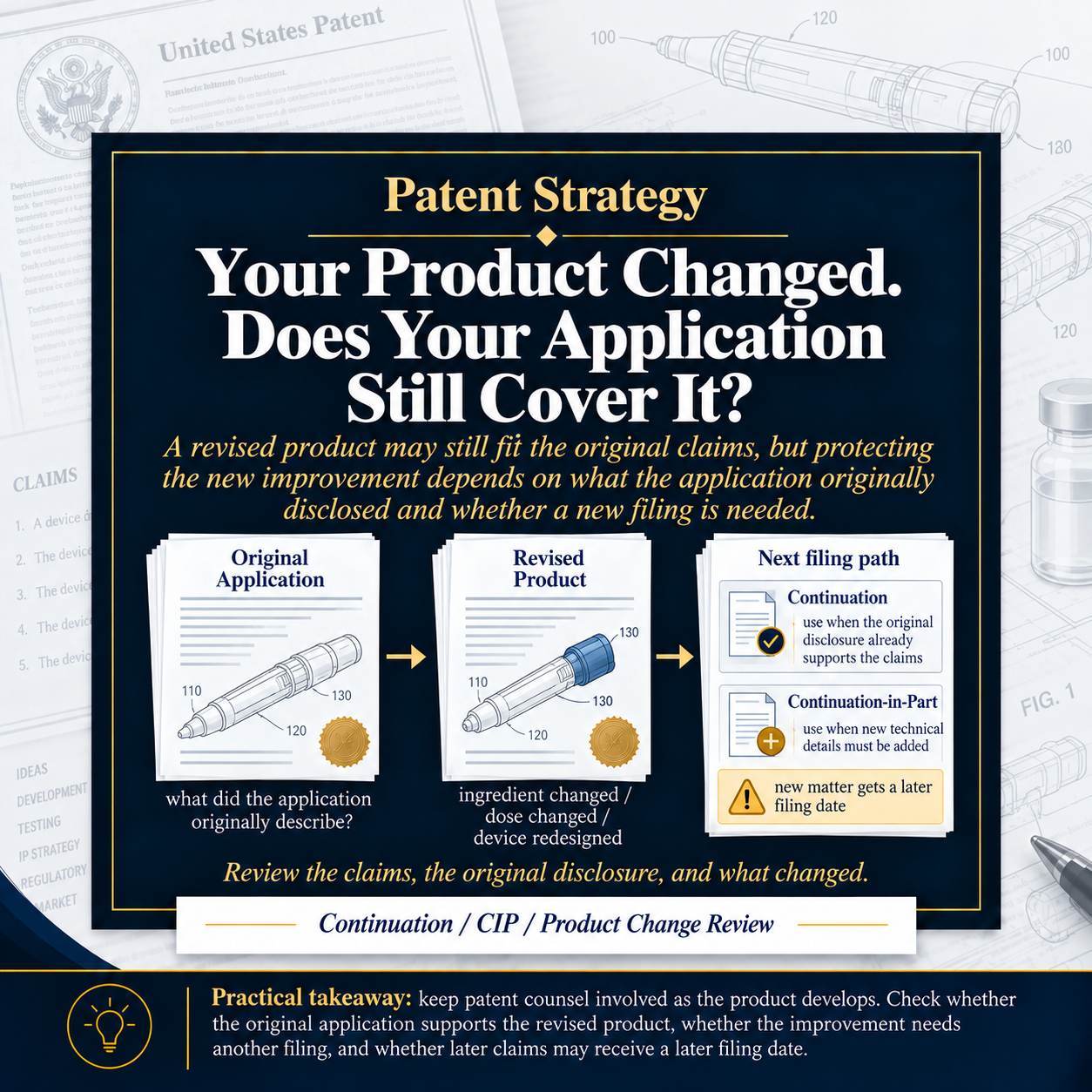
There is a second limit. A continuation cannot add new technical details.
Those details would require a different kind of filing. Claims relying on that new material would not receive the original filing date.
That is why the drafting matters from the start.
Describe meaningful variations, ranges, configurations, and methods in enough detail to support later claims. Simply mentioning an alternative may not be enough.
For medical-device, pharmaceutical, and formulation companies, those details may provide options as product plans develop. The allowed claims might address the current product, while another version described in the application could matter to a future launch or licensing discussion.
Practical takeaway: before the issue fee is paid, review the application with patent counsel against the company’s product plans.
Which commercially important features do the allowed claims cover?
Which versions are described in the application but remain unclaimed?
Would additional claims justify the cost of another application?
The USPTO recommends filing continuing applications before paying the issue fee. Treat that as a prompt to review the options early, rather than waiting for the patent to arrive.
A continuation is not necessary for every application. The point is not to file more applications simply because you can.
It is to decide whether additional protection would matter to the business.
Do not wait until the last pending application has issued to have that conversation.
Sources
USPTO, MPEP §§ 201.07–201.08. Explains continuation applications, further examination, and the distinction from applications that introduce new technical material. USPTO
https://www.uspto.gov/web/offices/pac/mpep/s201.html
USPTO, MPEP §§ 211.01(b) and 211.05. Explains pending-application requirements, support for an earlier filing date, and the recommendation to file continuing applications before paying the issue fee. USPTO
https://www.uspto.gov/web/offices/pac/mpep/s211.html