
Your team used AI during development.
Who gets named as the inventor?
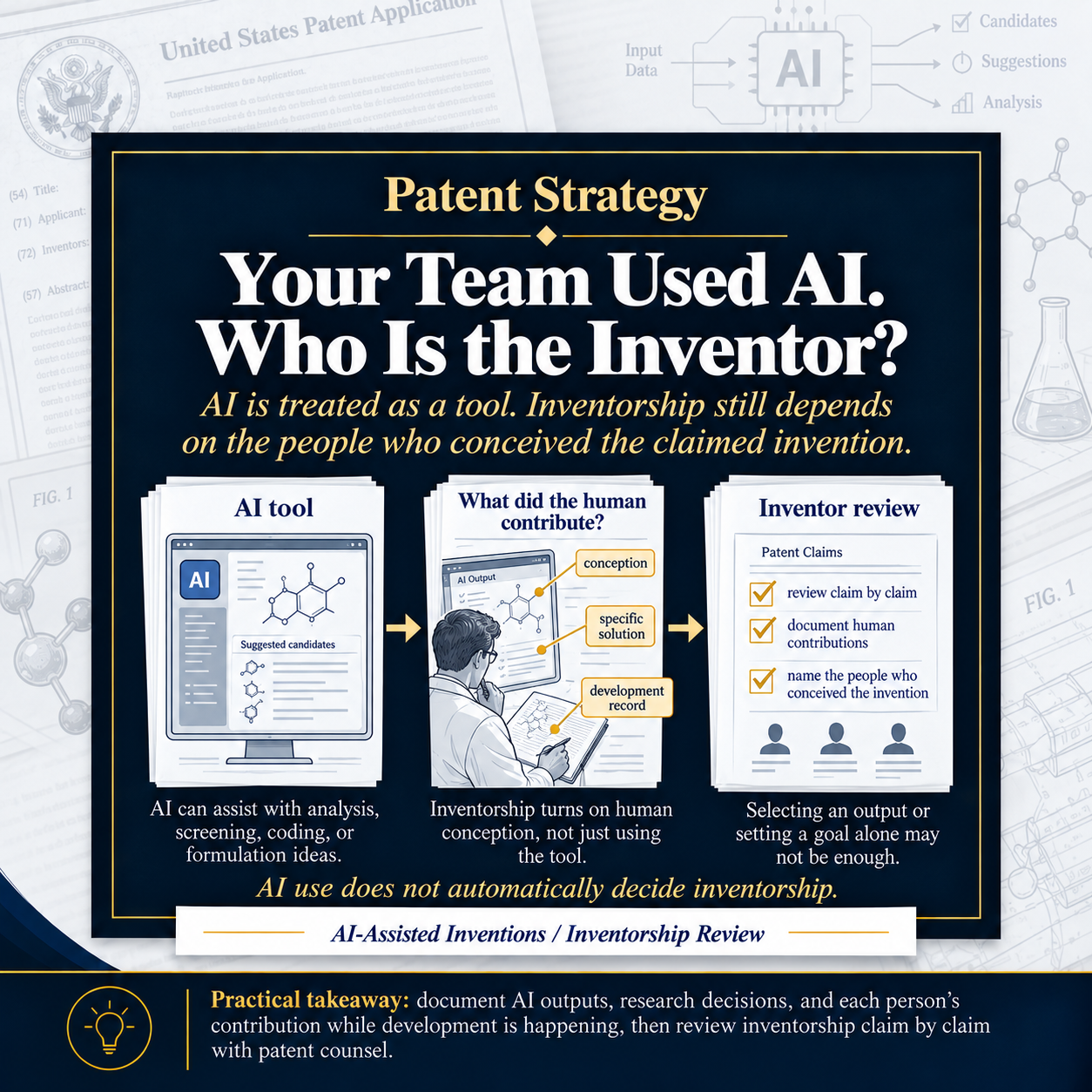
For a U.S. patent, only people can be named. But not automatically the person who used the tool.
In November 2025, the USPTO replaced its earlier guidance on AI-assisted inventions. The revised guidance says the same inventorship rules apply whether AI was used or not.
AI is treated as a tool, like modeling software or laboratory equipment.
Using it does not automatically disqualify a human inventor. But operating it does not automatically make someone an inventor, either.
The question is who conceived the invention.
In plain terms, who formed the specific, complete idea of the solution, rather than simply identifying a problem or setting a research goal?
Consider a formulation tool that proposes ingredient ratios.
Before naming the chemist as an inventor, review what actually happened. What did the tool suggest? What did the chemist contribute? How was the particular formulation being claimed developed?
The same review matters when AI helps screen drug candidates or generate medical-software code. Selecting an output or describing the desired result does not, by itself, settle inventorship.
These are questions to work through with patent counsel, not automatic answers based on someone’s job title.
Practical takeaway: for drug-discovery, formulation, and medical-software companies, document the human contributions while development is happening.
Keep relevant AI outputs alongside research notes, design decisions, and records of who contributed. Explain how the team arrived at the technical solution.
Do not wait until the application is being prepared to reconstruct that history.
There is a drafting connection, too.
Review the proposed claims alongside the development record. Identify who contributed to conceiving the invention each claim describes, rather than automatically naming everyone involved in the project.
Several people may qualify as joint inventors. But participation in the broader project is not enough by itself.
The purpose of the review is not to minimize the role AI played. It is to establish what the people actually contributed.
Using AI does not automatically put an invention outside the patent system.
But the application still needs to name the people who did the inventing.
Sources
USPTO, Revised Inventorship Guidance for AI-Assisted Inventions, November 2025. Confirms that ordinary inventorship standards apply and that AI systems are tools, not inventors. USPTO
https://www.uspto.gov/subscription-center/2025/revised-inventorship-guidance-ai-assisted-inventions
USPTO, Revised Inventorship Guidance for AI-Assisted Inventions, Federal Register, November 28, 2025. Explains conception and the fact-specific assessment of human inventorship. Federal Register
https://www.federalregister.gov/documents/2025/11/28/2025-21457/revised-inventorship-guidance-for-ai-assisted-inventions
USPTO, MPEP 2109, Inventorship. Addresses contributions to conception and the connection between inventorship and the claimed invention. USPTO
https://www.uspto.gov/web/offices/pac/mpep/s2109.html