

You Have a Patent. Are You Free to Sell?
Not necessarily.
A patent does not give you permission to make or sell a product. It gives you the right to stop others from making, using, or selling the invention covered by your claims.
Suppose your team develops a better drug-delivery device and obtains a patent on the improvement. But the device still uses a mechanism covered by someone else’s unexpired patent.
Your patent covers the improvement. Their patent may still prevent you from selling the finished device.
The same issue can arise with formulations. A new combination may be patentable while an ingredient, delivery method, or manufacturing process remains covered by another patent.
That is why a freedom-to-operate review asks a different question from a patentability review.
Not “Can we protect this?”
But “Could making or selling this infringe someone else’s patent?”
The review considers the actual product, where it will be manufactured and sold, what the relevant patent claims cover, and whether those patents are still in force.
Getting your own patent does not answer those questions.
If the review turns up a problem, there may be options. Redesign around the claims. Negotiate a license. Challenge the patent. Wait for it to expire.
It is better to assess those choices before launch commitments limit them.
Practical takeaway: for medical-device, pharmaceutical, and formulation companies, bring freedom-to-operate review into product development. Do not leave it until after the manufacturing commitments, distribution agreements, and marketing spend.
There is a drafting connection, too.
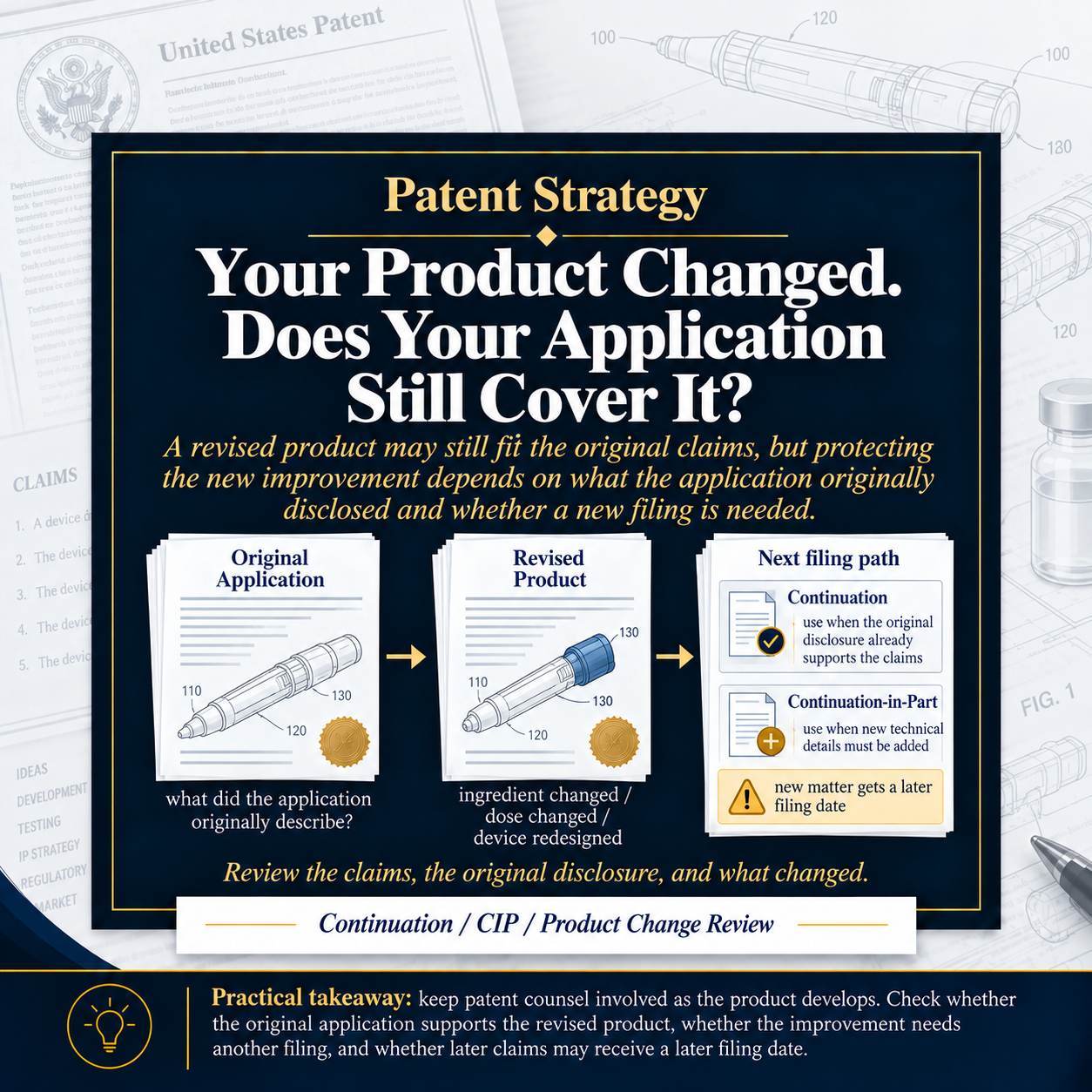
When preparing your own application, describe realistic alternative designs or formulations in enough detail to support later claims. That can help preserve options for your patent protection if the product changes.
You cannot simply add missing technical details to the application afterward.
But those alternatives still need a separate freedom-to-operate review. Describing or patenting another design does not establish that it is free to use.
A review cannot guarantee that no dispute will arise. But having your own patent is not a substitute for one.
Your patent protects what you claimed. It does not clear the path to market.
That is a separate question, and it is worth asking early.
Sources
USPTO, Patent Essentials and Managing a Patent.
https://www.uspto.gov/patents/basics/essentials
https://www.uspto.gov/patents/basics/manage
WIPO, Launching a New Product: Freedom to Operate.
https://www.wipo.int/en/web/wipo-magazine/articles/ip-and-business-launching-a-new-product-freedom-to-operate-34956
USPTO, MPEP § 608.04, New Matter.
https://www.uspto.gov/web/offices/pac/mpep/s608.html