
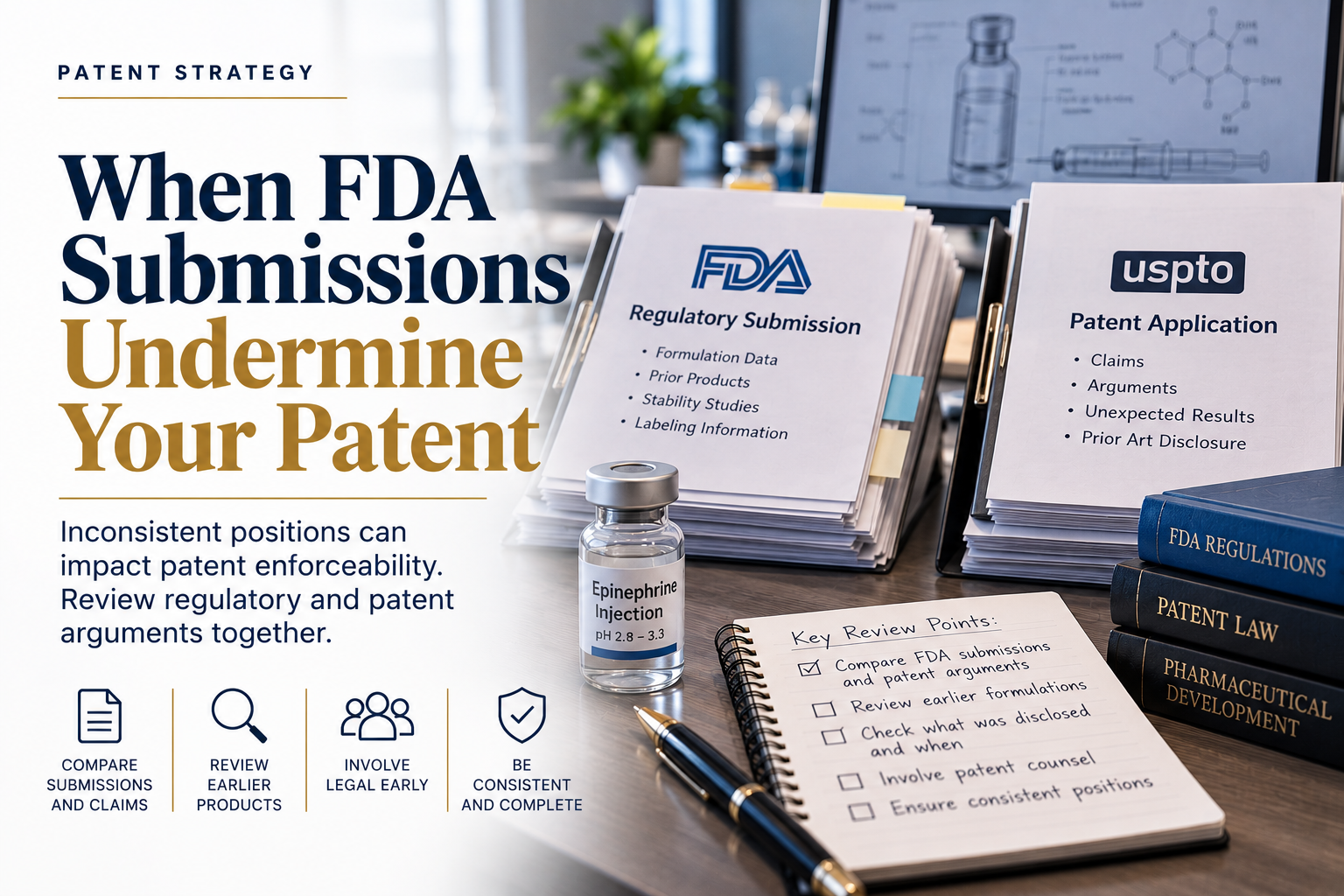
Your company told the FDA one thing. It told the Patent Office another.
In Belcher Pharmaceuticals v. Hospira, that conflict helped cost the company its ability to enforce its patent.
Belcher’s patent covered an injectable epinephrine formulation. After the examiner rejected the claims as obvious, Belcher argued that its pH range of 2.8 to 3.3 was critical and produced an unexpected result.
The examiner accepted the argument. The patent issued.
But Belcher’s FDA submissions relied on earlier epinephrine formulations using that same pH range.
Its chief science officer knew about them. He was involved in both the FDA submission and the patent application.
The information about those earlier products was not disclosed to the Patent Office.
When Belcher later sued Hospira, the court found that he had deliberately withheld material information with intent to deceive the Patent Office.
This was not simply two departments failing to compare notes.
The patent was held unenforceable for inequitable conduct. The Federal Circuit affirmed in 2021.
Practical takeaway: for pharmaceutical and medical-device companies, review FDA submissions and patent arguments together before presenting a feature as new, critical, or unexpected.
What earlier products did the company rely on during the regulatory process?
What did the testing show?
Has patent counsel reviewed that information alongside the proposed claims?
Give counsel the relevant submissions, studies, and information about earlier products. Counsel can assess what must also be disclosed to the Patent Office. That does not mean automatically submitting every document sent to the FDA.
There is a drafting lesson, too.
Before preparing the application, compare its description of the invention with the development records and regulatory submissions.
Explain what the company actually changed. Describe the results accurately and make sure the evidence supports any claim of an unexpected improvement.
Keep that review going when responding to the examiner. Share information that may complicate the argument, not just the results that support it.
A patent argument is only as strong as the facts behind it.
The goal is not to make the two submissions sound alike. It is to make sure the patent argument reflects what the company already knows.
Sources
Belcher Pharmaceuticals, LLC v. Hospira, Inc., Federal Circuit, September 1, 2021. The opinion addresses the FDA submissions, patent arguments, deliberate withholding, and the ruling that the patent was unenforceable.
https://www.cafc.uscourts.gov/opinions-orders/20-1799.opinion.9-1-2021_1828017.pdf
USPTO, MPEP 2001, Duty of Disclosure, Candor, and Good Faith. Explains the obligation to disclose known information material to patentability and the limits of that obligation.
https://www.uspto.gov/web/offices/pac/mpep/s2001.html