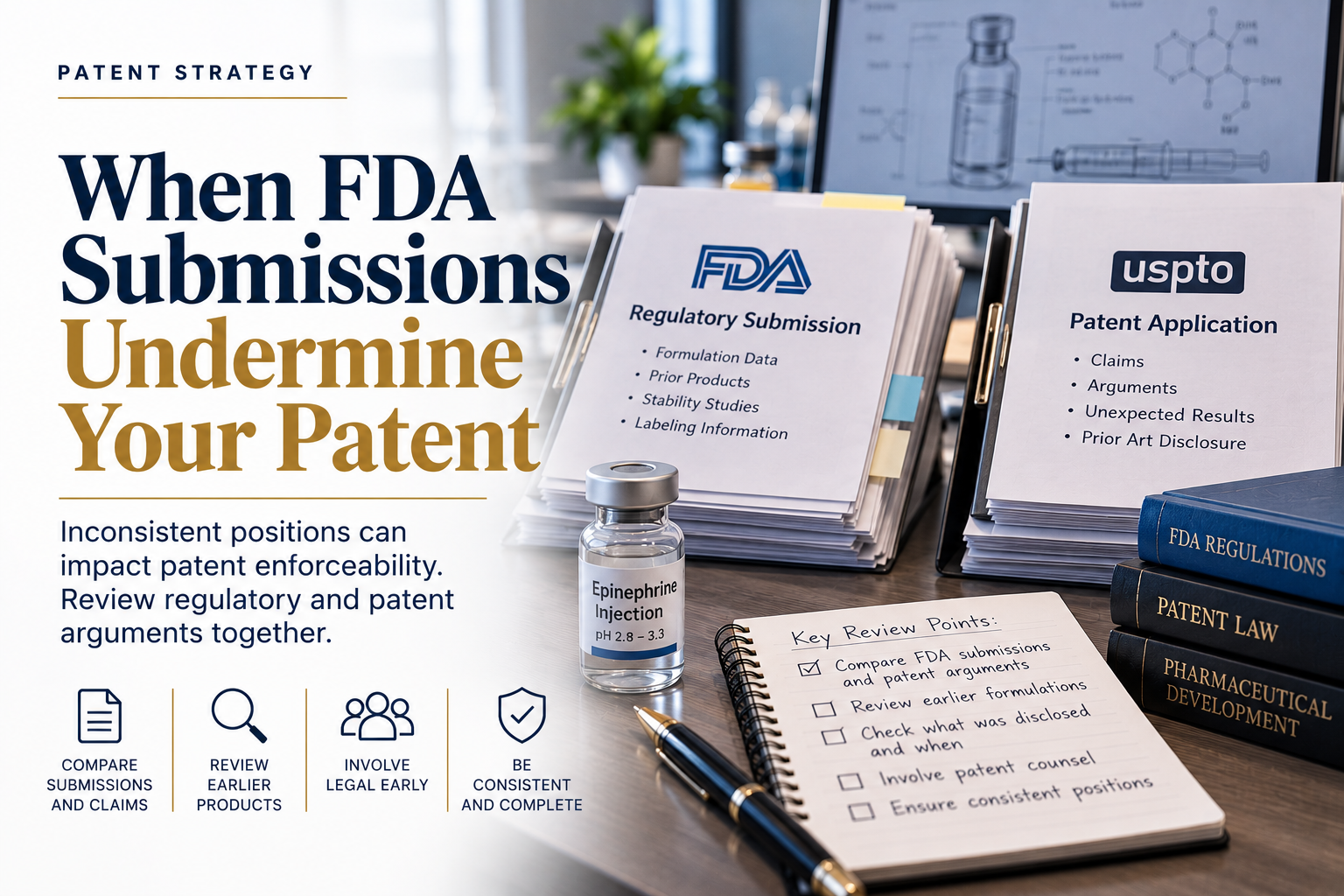

Your team replaced an ingredient, changed the dose, or redesigned part of the device.
Does the patent application still cover what you plan to sell?
Maybe. But it is worth checking.
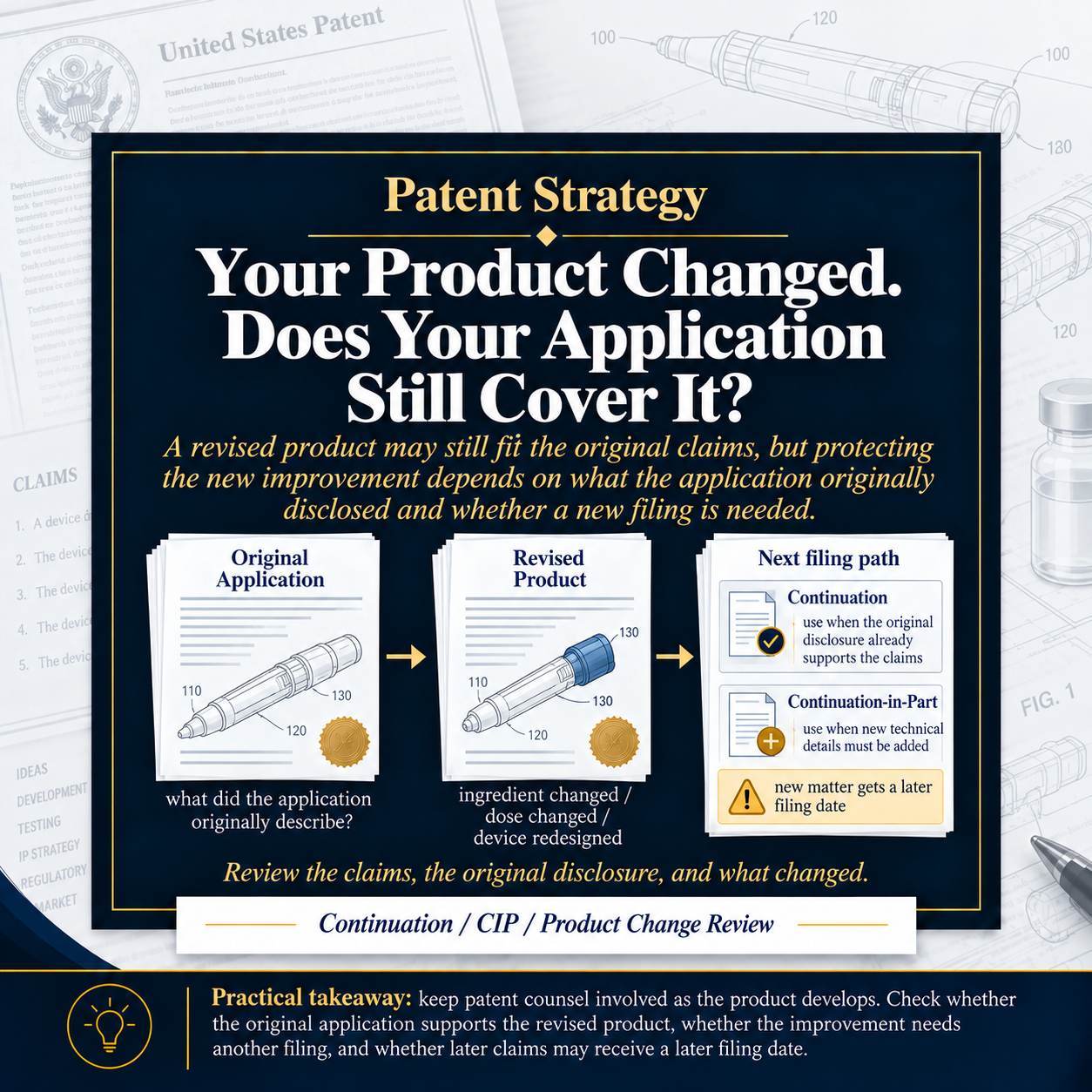
Product changes after patent filing do not automatically mean starting over. The first step is to review the claims, which define the protection you are seeking.
The existing claims might still cover the revised product. But that is different from protecting the improvement you added.
Those are two separate questions.
Next, look at what the application originally described.
If it already supports the claims you now want, you may be able to amend the pending claims or pursue another set in a continuation.
A continuation uses the earlier disclosure. It has its own filing date, but supported claims can receive the benefit of the earlier date if the filing requirements are met.
It must connect to a qualifying application that is still pending. It cannot add new technical material.
But what if the team developed something the original application never described?
You cannot simply update the application with the missing details. A new filing may be needed.
One U.S. option is a continuation-in-part application. It carries earlier material forward and adds new technical details. It also requires a qualifying earlier application to remain pending.
The new details do not get the old filing date.
Claims that depend on those additions receive a later date. Claims already supported by the original application may still qualify for the earlier one.
That difference matters. A later filing date can expose the new claims to additional prior art.
Have counsel review what became public in the meantime, including your own papers, press releases, and product launches. What was disclosed, when, and whether an exception applies all matter.
A continuation-in-part is not automatically the best choice. Discuss whether that route or a separate application makes more sense for the improvement.
Practical takeaway: for medical-device, pharmaceutical, and formulation companies, keep patent counsel involved as the product develops.
What changed?
Does the original application support claims to those changes?
Would protecting the improvement require another filing?
There is a drafting lesson, too.
When preparing the original application, describe meaningful alternative ingredients, ranges, and configurations the team can reasonably foresee. Explain them in enough detail to support the claims the company may want later.
After filing, keep the patent team informed when plans change.
Before the next launch or licensing discussion, check that the claims you are pursuing still match the product the company plans to sell.
Sources
USPTO, MPEP 201.07 and 201.08, Continuation and Continuation-in-Part Applications. USPTO
https://www.uspto.gov/web/offices/pac/mpep/s201.html
USPTO, MPEP 608.01(k) and 608.04, Statutory Requirement of Claims and New Matter. USPTO
https://www.uspto.gov/web/offices/pac/mpep/s608.html
USPTO, MPEP 211.05, Sufficiency of Disclosure in Prior-Filed Application. USPTO
https://www.uspto.gov/web/offices/pac/mpep/s211.html
USPTO, MPEP 2153.01(a), Grace Period Inventor-Originated Disclosure Exception. USPTO
https://www.uspto.gov/web/offices/pac/mpep/s2153.html