
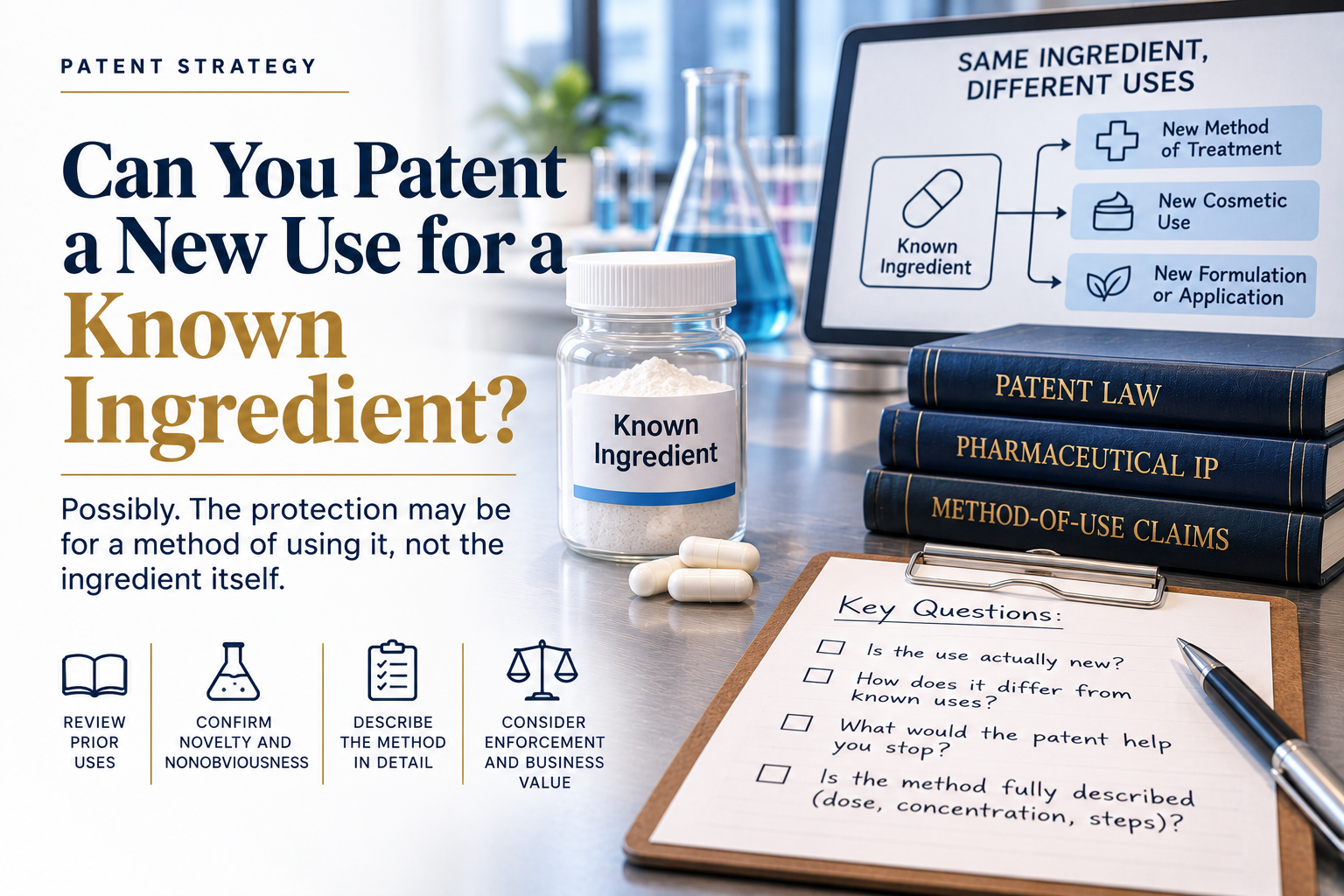
Your team found a new use for a known ingredient.
Can that be patented?
Possibly. But the protection may be for the method of using it, not the ingredient itself.
Two questions are worth asking.
First, is the use actually new?
If an already-known method necessarily produces the benefit you discovered, recognizing that benefit does not make the method new.
Compare the method you want to claim with what earlier uses and publications already taught.
A different dose, patient group, or way of applying the ingredient could matter. But those differences still need to make the claimed method new and nonobvious.
Second, what would the patent help you stop?
A patent on one use does not automatically block every sale of the ingredient. But a seller may still be liable for knowingly encouraging infringement.
Review who performs the claimed steps and whether a competitor encourages that use through its instructions or marketing. The patent claims and the competitor’s conduct need to be considered together.
Practical takeaway: for pharmaceutical, cosmetic, and herbal-product companies, review both questions with patent counsel before building a strategy around the new use.
There is a drafting connection, too.
The application needs to teach the method, not just name a possible benefit.
Explain how to carry it out, including relevant doses, concentrations, or application steps. Include supporting evidence where available.
Make sure the claims describe the method the team developed, rather than simply the result it hopes to achieve.
A known ingredient can still support valuable patent protection.
The question is whether the new use is patentable and whether protecting it would matter to the business.
Sources
USPTO, MPEP 2112 and 2112.02, Inherency and Process Claims. Explains the distinction between a new use and a newly recognized benefit of an existing method. USPTO
https://www.uspto.gov/web/offices/pac/mpep/s2112.html
USPTO, MPEP 2164, The Enablement Requirement. Explains the disclosure needed to teach others how to make and use the claimed invention. USPTO
https://www.uspto.gov/web/offices/pac/mpep/s2164.html
35 U.S.C. 271, Infringement of Patent. Addresses direct infringement and liability for inducing infringement. Legal Information Institute
https://www.law.cornell.edu/uscode/text/35/271