
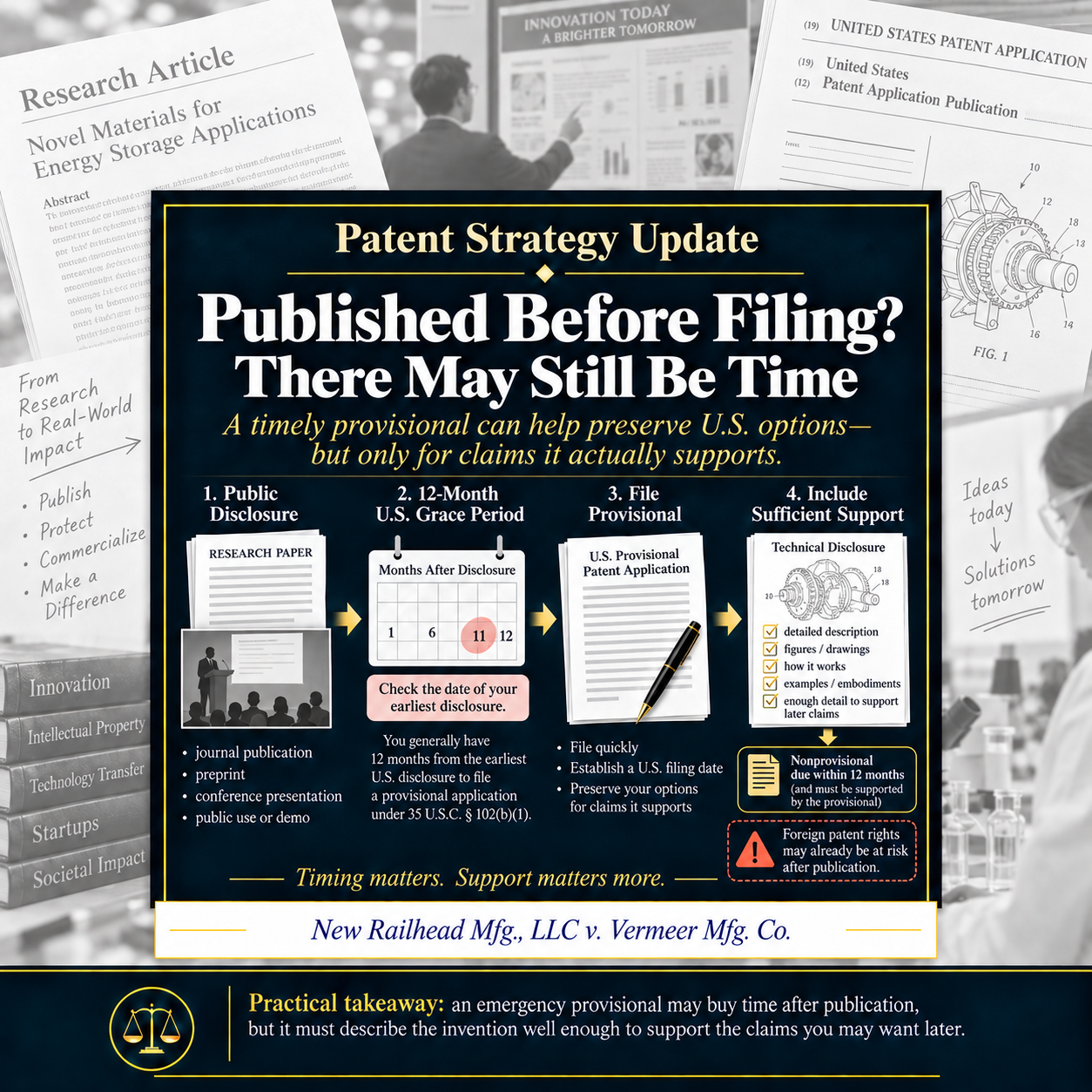
Already published the paper without filing a patent application?
There may still be time to act in the United States.
Inventors generally have one year after their own public disclosure to file. But check the earliest disclosure. A preprint, public poster, or presentation may have started the clock before the journal paper appeared.
If you are eleven months in, an emergency provisional patent application may still preserve U.S. patent options. But it needs to describe the invention and explain how to make and use it.
Just getting something filed is not enough.
New Railhead v. Vermeer shows why. The company filed a provisional within a year of offering its drill bit for sale. But the filing did not adequately describe how the bit was angled relative to its housing—a feature required by the later patent claims.
Those claims could not use the provisional’s earlier date. The company’s own sales then invalidated the drill-bit patent.
That 2002 case involved sales under older U.S. patent law, not research publications. But it illustrates why the contents of a provisional matter just as much as the filing deadline.
Practical takeaway: for research teams, the paper can be a starting point. It should not be assumed to contain everything the patent application needs.
Have patent counsel check for missing technical details, including variations and ranges the team may want to claim later. Address those gaps before filing—not after the deadline has passed.
There is follow-up work, too. The team normally needs to file a nonprovisional within 12 months of the provisional and properly claim its benefit. Only adequately supported claims receive that earlier date.
And do not assume this preserves protection abroad. Publishing before filing may already have closed those options.
For researchers and the companies licensing their work, build patent review into the publication process. Bring patent counsel or the technology-transfer office into the conversation before the preprint, poster, or presentation goes public.
An emergency provisional is a safety measure, not a strategy.
It is worth discussing when a deadline is approaching. But the better time to check patent options is before publication.
Sources:
USPTO, Provisional Application for Patent — guidance on the disclosure deadline, provisional requirements, follow-on filings, and risks to foreign patent protection.
https://www.uspto.gov/patents/basics/apply/provisional-application
New Railhead v. Vermeer, Federal Circuit, 2002 — the provisional-support ruling is also discussed in USPTO MPEP § 211.05.
https://law.justia.com/cases/federal/appellate-courts/F3/298/1290/643013/