
Sometimes the argument that wins you a patent is the same one that shrinks it.
Azurity Pharmaceuticals learned that in its case against Alkem Laboratories.
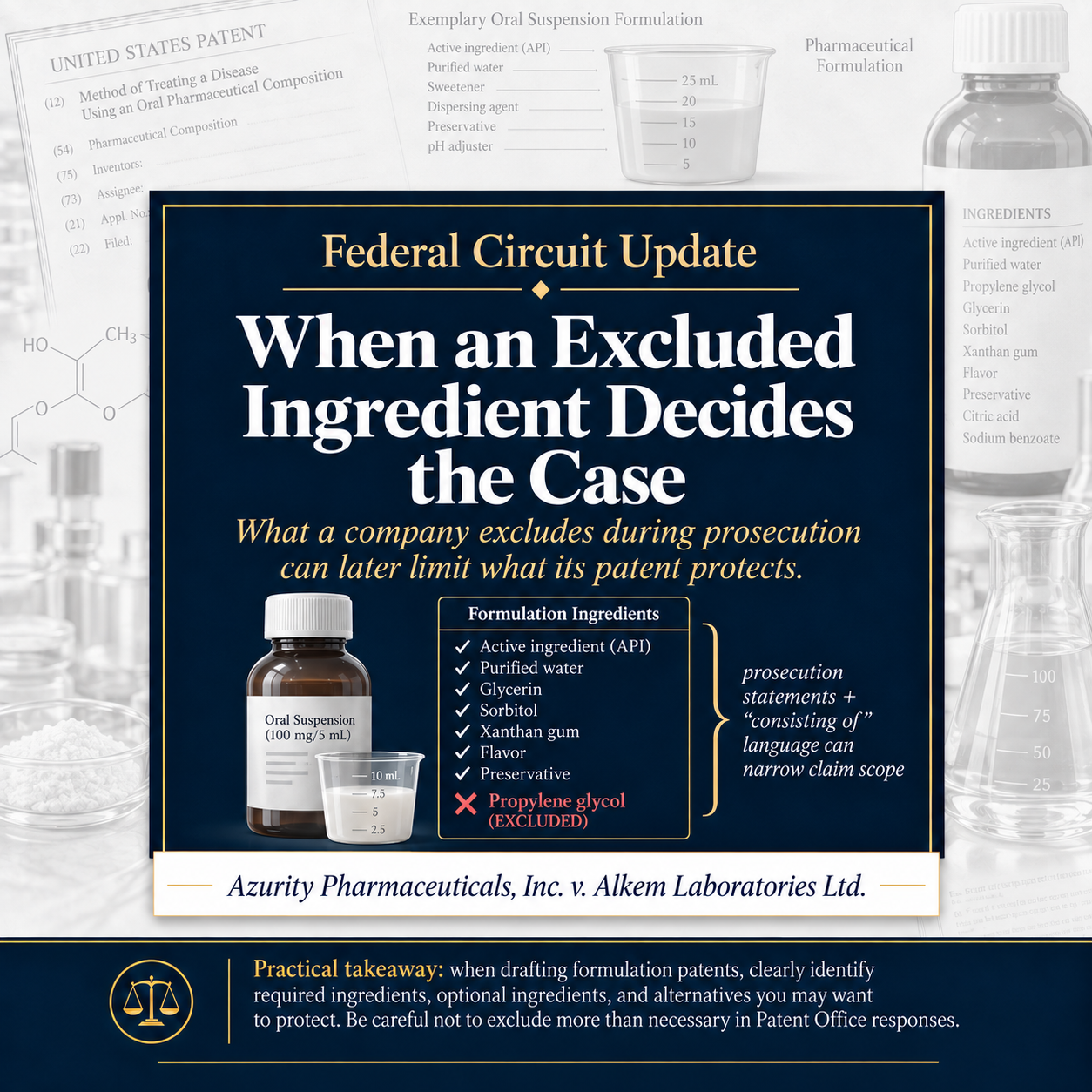
Azurity’s patent covered a liquid form of the antibiotic vancomycin. During the application process, the company needed to distinguish its formula from an earlier one that contained propylene glycol. Azurity repeatedly told the Patent Office that its formula did not contain that ingredient.
That distinction helped Azurity get the patent. The patent also used wording that limited the formula to the ingredients it specifically listed.
Alkem’s proposed generic version contained propylene glycol as part of its flavoring. Azurity sued, arguing that its earlier statements did not exclude the ingredient when it was used in a flavoring.
The Federal Circuit disagreed.
Azurity had excluded propylene glycol entirely. Using it in a flavoring did not change that.
The court did not cancel the patent. But Azurity could not use it to block Alkem’s proposed product.
That is the part product-development and formulation teams should pay attention to. Before excluding an ingredient to get a patent, consider which products that decision could leave unprotected.
Could a future version of the company’s own product use that ingredient?
Could a competitor add it and design around the patent?
Does the application describe the other formulas the company may want to protect?
Practical takeaway: patent drafting should happen alongside product planning, not after it. Explain which ingredients are required, which are optional, and which can be replaced. Describe the alternative formulas the company may want to develop.
Keep those possibilities in mind when responding to the Patent Office, too. An exclusion should be a deliberate decision—not something the company understands only when a competitor uses the excluded ingredient.
Distinctions like these are often necessary to get a patent. The goal is not to avoid them.
The goal is to know what protection the company may be giving up before making them.
Source:
Azurity Pharmaceuticals, Inc. v. Alkem Laboratories Ltd.
Federal Circuit, April 8, 2025.
https://www.cafc.uscourts.gov/opinions-orders/23-1977.OPINION.4-8-2025_2495069.pdf