
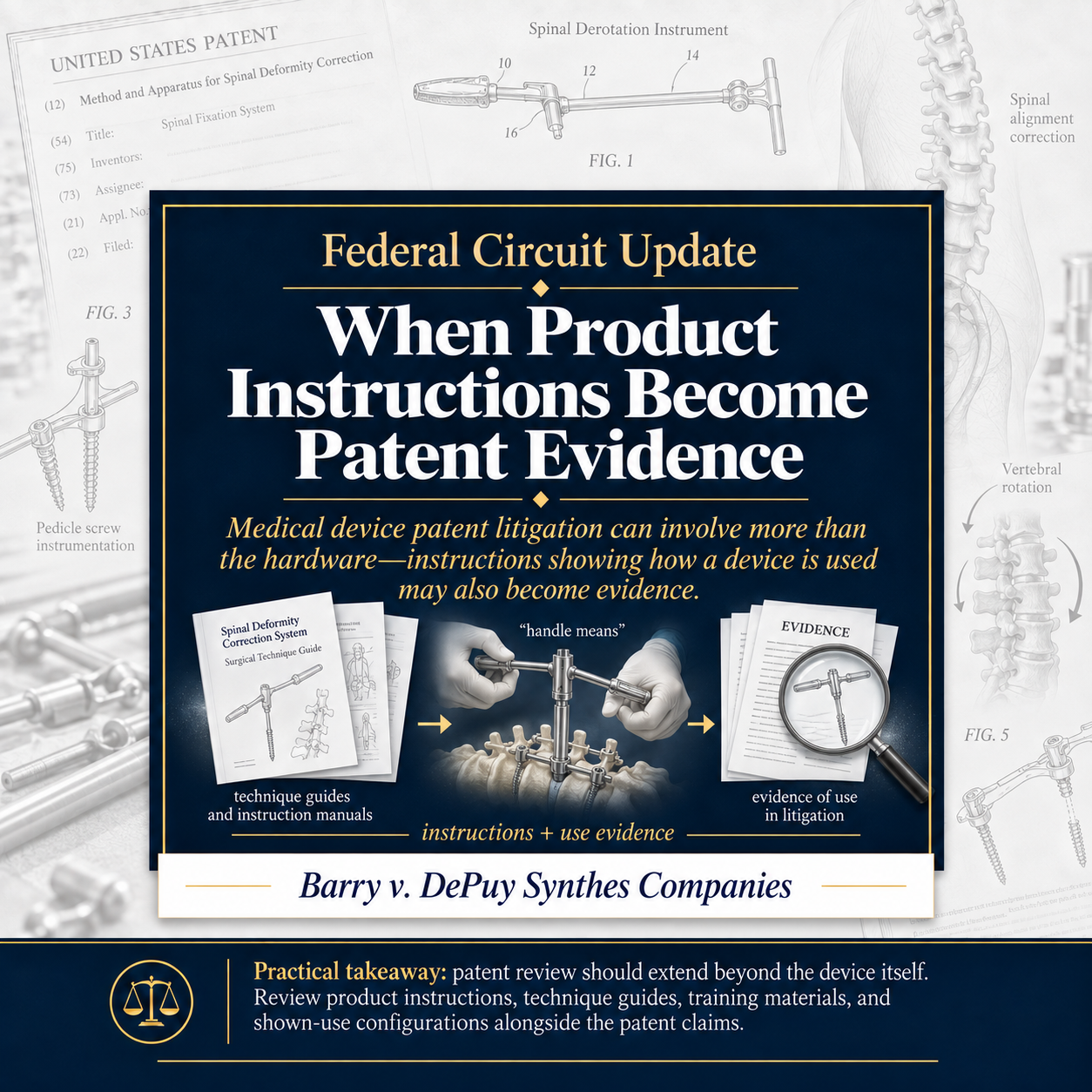
Your device is not the only thing that needs a patent review.
Your instruction manual does, too.
That is the lesson worth taking from Barry v. DePuy Synthes.
Dr. Barry holds patents on spinal-surgery tools and techniques. He argued that DePuy did not just sell its devices, it taught surgeons to use them in a way that infringed.
The evidence? DePuy’s own materials.
Instruction manuals. Technique guides. Brochures showing surgeons how to grasp the tools. Plus expert testimony and a survey of surgeons.
The district court excluded two of Barry’s experts and ruled for DePuy.
The Federal Circuit reversed and sent the case back for a new trial.
The key distinction: an expert is not allowed to contradict the court’s reading of a patent claim. But applying that reading to the facts is different. The court found Barry’s expert had applied it, and disputes over how it applies are for the jury to decide.
To be clear: no one has decided DePuy infringed. That question goes back for trial.
But the lesson for device companies stands either way.
Patent risk does not stop at the hardware. It extends to what you teach people to do with it.
Instruction manuals, technique guides, training decks, marketing materials. All of it can become evidence.
So a patent review should include engineering, clinical-training, and marketing teams. Not just the people who designed the device.
https://www.cafc.uscourts.gov/opinions-orders/23-2226.OPINION.1-20-2026_2634511.pdf