
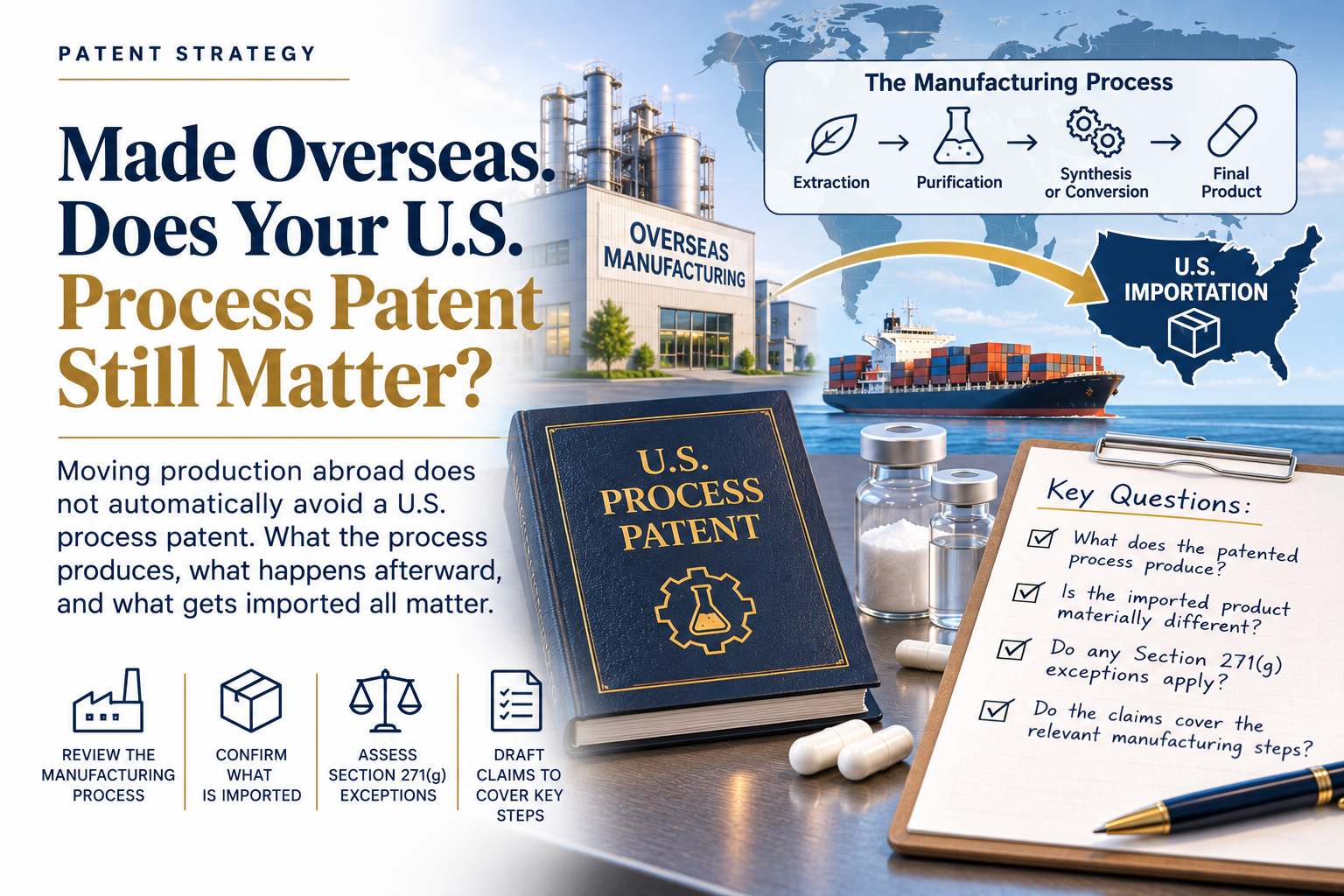
A competitor uses your patented process overseas, then ships the product to the United States.
Does moving production abroad avoid the patent?
Not necessarily.
Under Section 271(g), importing, selling, or using that product in the United States without permission can infringe while the U.S. process patent is in force.
But what happens before importation matters.
The law includes exceptions when later processing materially changes the product, or when it becomes a trivial and nonessential component of another product.
Eli Lilly v. American Cyanamid illustrates why those limits deserve attention.
The patented process produced an intermediate compound that was later converted into the antibiotic cefaclor. The courts found significant changes in its chemical structure and properties.
In 1996, the Federal Circuit upheld the denial of a preliminary injunction.
The lesson is not that every additional manufacturing step avoids infringement. It is that the product made by the patented process and the product imported into the United States may be materially different.
Practical takeaway: for pharmaceutical, formulation, and extraction businesses, review the manufacturing process alongside the finished product.
Does an extraction method, purification sequence, or production technique deserve its own patent claims?
What happens to the material after that process is completed?
What actually crosses the U.S. border?
There is a drafting connection, too.
When preparing the application, explain the relevant manufacturing stages, conditions, and variations. Describe what each stage produces and how the process is carried out.
Then review which claims the application can support and how the company could establish that a competitor used the claimed process.
Adding more manufacturing steps does not automatically make a claim harder to avoid. The goal is to seek useful protection, not simply write a longer claim.
For an existing application, a continuation may offer an opportunity to pursue process claims if a qualifying application remains pending.
But the original disclosure must already support those claims. Missing manufacturing details cannot simply be added.
A U.S. process patent is not worldwide manufacturing protection.
But an overseas factory does not necessarily put products entering the U.S. market beyond its reach.
Sources
35 U.S.C. 271(g), Infringement of Patent. Covers specified U.S. activities involving products made by patented processes and the two product exceptions. U.S. Code
https://uscode.house.gov/us/usc/119-120/t35/s271/
Eli Lilly & Co. v. American Cyanamid Co., Federal Circuit, 1996. Addresses material changes to a pharmaceutical intermediate and affirms the denial of a preliminary injunction. Justia Law
https://law.justia.com/cases/federal/appellate-courts/F3/82/1568/485455/
USPTO, MPEP 201.07, Continuation Application. Explains continuation applications and the restriction against adding new matter. USPTO
https://www.uspto.gov/web/offices/pac/mpep/s201.html