
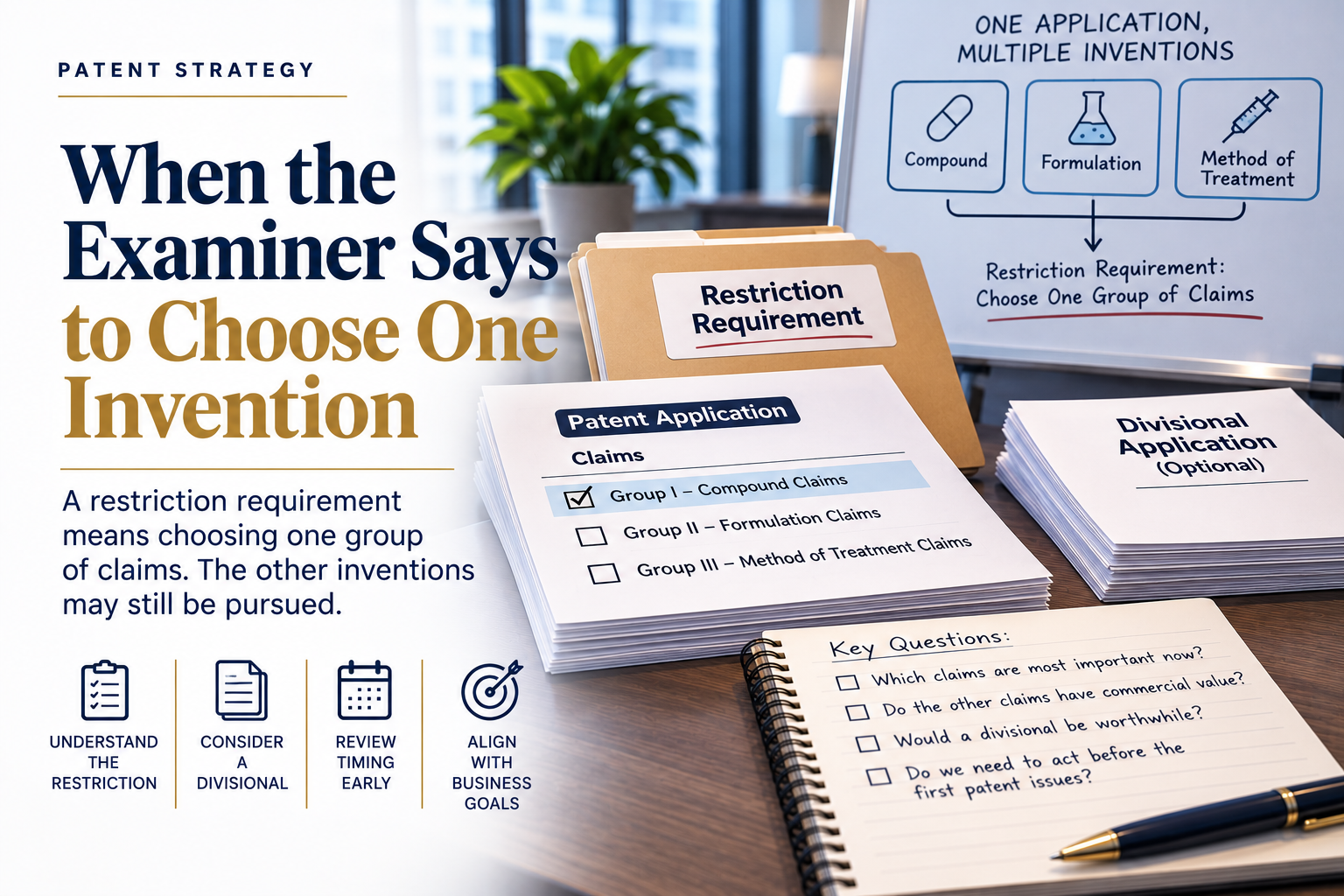
The examiner says your application contains more than one invention. You need to choose one group of claims for examination.
What happens to the rest?
This is called a restriction requirement.
An application might claim a compound, a formulation, and a method of treatment. Or a device, a method of using it, and a kit. If the examiner requires a split, the company selects one group for examination.
The other claims are generally withdrawn from examination. That is not a finding that those inventions cannot be patented.
One option for pursuing them is a divisional application.
A divisional is a separate application based on the original disclosure. It has its own filing date, but its claims can receive the benefit of the earlier date if the disclosure supports them and the filing requirements are met.
Timing matters.
A divisional must connect to a qualifying application that is still pending. Another properly linked pending application may preserve that opportunity after the first patent issues.
But review the filing plan before the first patent issues, rather than assuming the option will remain available.
A separate filing is not always necessary. Patent counsel can assess whether to challenge the restriction. In some circumstances, withdrawn claims can also return to examination when the chosen claims are allowable.
The business decision deserves just as much attention as the filing process.
Suppose the team chooses the product claims because those matter most to the upcoming launch. The method or kit claims get set aside and never revisited.
Those other inventions could still matter to a future product, manufacturing arrangement, or licensing deal.
Practical takeaway: for medical-device, pharmaceutical, and formulation companies, give the withdrawn claims the same commercial review as the claims selected for examination.
Does the method of treatment matter to the business?
Could the formulation or kit support another product or licensing opportunity?
Would pursuing that protection justify the additional cost?
There is a drafting connection, too.
The original application must support the invention pursued in the divisional. Missing technical details cannot simply be added later.
When preparing the original application, explain the relevant products, manufacturing methods, and uses in enough detail to support the claims the company may want to pursue separately.
When the examiner splits the claims, treat it as a decision point, not a loss.
The claims you did not choose may be worth a patent of their own.
Sources
USPTO, MPEP 802, Basis for Restriction Practice in Statute and Rules. USPTO
https://www.uspto.gov/web/offices/pac/mpep/s802.html
USPTO, MPEP 201.06, Divisional Application. USPTO
https://www.uspto.gov/web/offices/pac/mpep/s201.html
USPTO, MPEP 211.01(b) and 211.05, Copendency and Support for an Earlier Filing Date. USPTO
https://www.uspto.gov/web/offices/pac/mpep/s211.html
USPTO, MPEP 821, Treatment of Claims to Nonelected Inventions and Rejoinder. USPTO
https://www.uspto.gov/web/offices/pac/mpep/s821.html